



Why More Shore Property Owners Are Exploring 1031 Exchanges
For many long-time property owners in coastal resort communities, appreciation has created extraordinary wealth over the last decade. Properties purchased years ago for under $1 million are now selling for several million dollars in highly desirable coastal communities.
Along the South Jersey coast, affectionately known simply as “the Shore,” demand for second homes and investment properties has remained exceptionally strong. Communities like Avalon, Stone Harbor, Ocean City, Sea Isle City, Long Beach Island, and surrounding coastal markets continue to attract investors, vacation homeowners, and high-net-worth buyers seeking both lifestyle and long-term appreciation opportunities.
As 1031 CORP. continues expanding its presence in one of the country’s hottest second-home real estate markets, our newest branch serving the South Jersey Shoreline is helping more investors navigate the unique opportunities and challenges associated with highly appreciated coastal investment properties.
While appreciation has created significant wealth for many owners, it has also created a major challenge when it’s time to sell.
Federal capital gains taxes, state income taxes, depreciation recapture, and the Net Investment Income Tax can significantly reduce the proceeds available for reinvestment.
Fortunately, a properly structured 1031 exchange may provide an opportunity to defer those taxes and preserve more equity for future investments.
One recent scenario involving a South Jersey Shore property owner demonstrates just how powerful that strategy can be.
The Scenario: A Highly Appreciated Avalon Rental Property
A married couple had owned a rental property in Avalon, New Jersey for approximately ten years. Over that time, the property experienced substantial appreciation as demand for Shore properties continued to increase.
This recent case study represents a fairly typical exchange scenario we are seeing throughout today’s Shore market, where long-term owners of highly appreciated vacation area rental properties are looking to reposition assets without losing significant equity to taxes.
Property Details
- Original purchase price: approximately $800,000
- Capital improvements: none
- Depreciation taken: approximately $180,000
- Current market value: approximately $5 million
- Debt: none
- Property use: always held as a rental investment property
Like many Shore investors, the couple loved the market and wanted to continue investing near the coast. Their goal was to acquire a larger property closer to the water that could generate higher rental income and long-term appreciation potential.
But there was one major obstacle. Selling the property outright would likely trigger a massive tax bill.
The Hidden Tax Impact of Selling Investment Property
Many investors focus primarily on the sale price of their property. However, the tax consequences of selling highly appreciated real estate can come as a surprise. In this case, the estimated taxable gain was approximately $4.2 million.
That created potential exposure to:
- 15 – 20% Federal capital gains taxes
- Up to 10.75% New Jersey state income taxes
- 3.8% Net Investment Income Tax (NIIT)
- 25% Depreciation recapture taxes
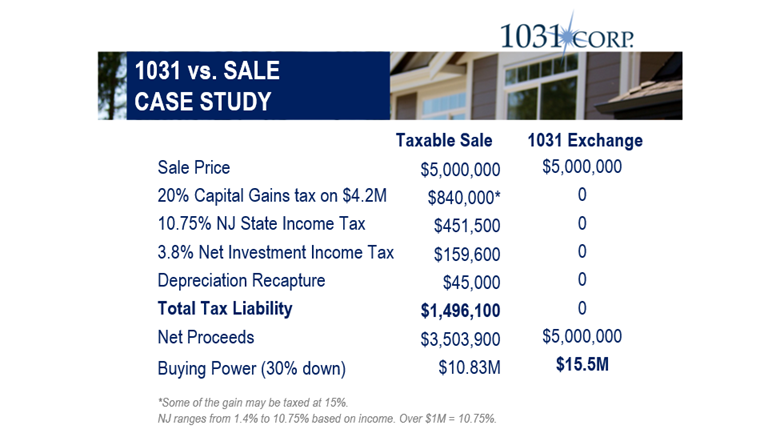
Estimated tax exposure included:
- Approximately $840,000 in federal capital gains taxes
- Approximately $451,500 in New Jersey state income taxes
- Approximately $159,600 in Net Investment Income Tax
- Approximately $45,000 in depreciation recapture taxes
Total Estimated Tax Liability: Approximately $1.5 million
Without planning, the couple would have reduced their reinvestment capital from $5 million to approximately $3.5 million after taxes. That reduction in available equity would significantly limit their future investment opportunities.
The 1031 Exchange Strategy
Instead of selling outright and paying taxes immediately, the couple chose to complete a properly structured 1031 exchange.
Section 1031 of the Internal Revenue Code allows investors to defer recognition of capital gains taxes when exchanging investment or business-use real estate for qualifying replacement property. By utilizing a 1031 exchange, the couple preserved the full $5 million of equity for reinvestment. This dramatically increased their purchasing power.
The Power of Leverage
One of the most overlooked advantages of a 1031 exchange is how tax deferral impacts leverage and acquisition potential. Assuming conventional financing with approximately 30% down:
- Without a 1031 exchange, purchasing power was approximately $10.8 million
- With a 1031 exchange, purchasing power increased to approximately $15.5 million
The Difference: Approximately $4.7 million in additional buying power
That additional acquisition power opened the door to significantly larger and more desirable investment opportunities closer to the ocean or bay.
Why This Matters for Shore Property Owners
Many Shore property owners purchased properties years before today’s dramatic appreciation occurred in coastal markets. As values continue to rise, tax exposure rises alongside them.
For investors considering selling highly appreciated Shore rentals, a properly planned 1031 exchange may create opportunities to:
- Preserve more investment capital
- Upgrade into larger or more desirable properties
- Improve rental cash flow
- Relocate closer to premium waterfront property
- Diversify real estate holdings
- Continue building long-term wealth using pre-tax dollars
For many investors, preserving equity rather than immediately paying taxes can substantially impact long-term portfolio growth.
Additional Benefits Beyond Tax Deferral
In this scenario, the benefits extended beyond preserving their equity. Because the deferred gain was not immediately recognized as taxable income, the couple potentially avoided having all their annual income taxed at the highest marginal rates during the year of sale.
The exchange also created opportunities for:
- Additional depreciation deductions
- Greater long-term appreciation potential
- Stronger rental income from upgraded assets
- More strategic estate planning opportunities
Planning Is Critical
A successful 1031 exchange requires advance planning and coordination. Important deadlines, identification rules, and documentation requirements apply to every exchange transaction. Investors should begin discussions with their advisors before listing a property for sale whenever possible.
Early planning often creates substantially more flexibility and better outcomes.
Final Thoughts
This Avalon case study demonstrates how a 1031 exchange can become much more than a tax strategy.
For many investors, it becomes:
- a wealth preservation strategy,
- a portfolio growth strategy,
- and a long-term investment planning tool.
As Shore property values continue to rise, more investors are exploring how strategic tax deferral may help them preserve equity and unlock larger future opportunities.
With the expansion of 1031 CORP.’s newest branch serving the South Jersey Shore, our team is uniquely positioned to help investors navigate the increasingly sophisticated opportunities emerging throughout one of the nation’s most active second-home and vacation rental markets.
If you own highly appreciated investment property, now may be the ideal time to evaluate your options.
Ready to Explore Your Options?
Contact 1031 CORP. today for a complimentary consultation.